

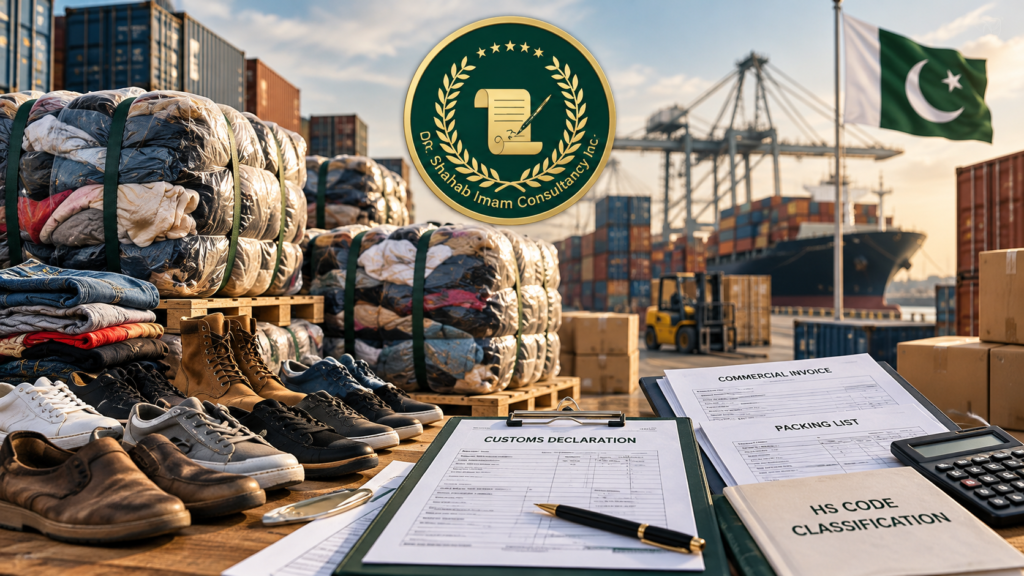
Businesses can import used clothes in Pakistan, and used shoes, when the shipment meets the rules that apply to it. A commercial importer needs tax registration, access to Pakistan Single Window (PSW, Pakistan’s online trade platform), correct customs classification, accurate documents, and a Goods Declaration (GD), the form filed with Customs for each shipment. Customs then assesses duties and taxes.
Quick Facts
- Used clothes and shoes are absent from the 2022 Import Policy Order’s list of goods banned in used condition, and each shipment is still checked against the current rules.
- Worn clothing and worn shoes have separate tariff codes, 6309.1010 and 6309.1020, in Pakistan’s 2026-27 customs tariff.
- Customs duty on worn clothing and worn shoes is 5% and regulatory duty is 8%, with sales tax and income tax at import collected as well.
- A commercial shipment is declared through PSW with an invoice, packing list, and transport document, plus any permit the goods require.
- Wrong codes, incomplete documents, and value questions can delay clearance, and professional customs support can help with these issues.
Can You Legally Import Used Clothes and Shoes into Pakistan?
Yes, commercial imports of used clothes and shoes are allowed when the shipment meets the rules that apply to it. The Ministry of Commerce’s Import Policy Order, 2022 allows goods from worldwide sources unless it bans or restricts them, and the order as issued in 2022 does not list worn clothing or shoes among goods banned in used condition.
A second-hand clothes import into Pakistan for resale is a commercial import, declared on a GD in the importer’s name. Personal items carried by travellers fall under the Baggage Rules, 2006.
Pakistan customs rules for used clothing start with the import policy and the customs tariff. In the 2022 order, Appendix-C, the list of goods banned in used condition, covers items such as machinery, appliances, and vehicles. Statutory Regulatory Order (SRO) 1207(I)/2026, dated 29 July 2026, amended the order without adding worn clothing or shoes. The same order bans counterfeit products, so branded items are confirmed as genuine before a shipment is bought. The tariff gives clothing and shoes separate codes, so each is classified on its own.
What Do You Need Before Importing Used Clothes into Pakistan?
Before ordering, an importer needs the registrations that let it file a declaration in its own name, and a supplier whose documents will match the cargo. Registration comes first, because PSW accepts declarations only from subscribed users. Supplier documents come next, because Customs checks the shipment against them.
What Business and Tax Registration May Be Required?
A National Tax Number (NTN) from the Federal Board of Revenue (FBR) is the starting point for every commercial importer, and FBR requires importers to register for sales tax. A PSW subscription, linked to the importer’s bank profile, lets the business file declarations. These registration steps are covered in more detail under import and export registration in Pakistan. Company registration papers depend on how the business is set up.
The Import Policy Order sets no product-specific licence for worn clothing or worn shoes. The Trade Development Authority of Pakistan (TDAP) also states that a general importer registration is no longer required.
Why Should You Verify Your Supplier Before Shipping?
Supplier documents are useful only if they describe the cargo exactly, so the commercial invoice and packing list are checked against the agreed order before shipment. The agreed delivery term (the trade term that sets who pays freight and insurance) is recorded in the PSW with the payment details. A description that separates worn clothing from worn shoes keeps each item under its correct code.
What Documents Are Required to Import Used Clothes and Shoes?
A used clothing shipment is cleared on a set of commercial, transport, and declaration documents. The documents required for importing used clothes depend on the goods, the shipment, its origin, and the import conditions that apply, so the list is confirmed before the goods leave the supplier.
These documents make up the clearance file:
| Document | Why it matters |
| Commercial invoice | Shows the transaction and the declared purchase value |
| Packing list | Identifies the goods, packages, and quantities |
| Bill of lading or air waybill | Confirms that the carrier has received the cargo |
| Goods Declaration (Single Declaration in PSW) | Records the shipment details for customs clearance |
| NTN and registration details | Establishes the importer’s identity and tax registration |
| Permits or certificates | Apply only where the rules for the goods demand them |
Which HS Codes Apply to Used Clothes and Shoes in Pakistan?
Used clothes and shoes presented in bulk, such as in bales or sacks, fall under heading 63.09, worn clothing and other worn articles, in Pakistan’s customs tariff. The Harmonized System (HS) is the international numbering system for traded goods, and the Pakistan Customs Tariff (PCT) extends HS headings into longer national codes that determine the duty.
In FBR’s Pakistan Customs Tariff 2026-27, the used clothing HS code in Pakistan is 6309.1010, worn shoes are 6309.1020, and other worn articles are 6309.1090. Under the Harmonized System’s notes to Chapter 63, heading 63.09 covers only articles that show signs of appreciable wear and are presented in bulk or in bales, sacks, or similar packings.
Used or new rags fall under a different heading, 63.10, at 20% customs duty, so a shipment mixing wearable garments with rags is classified part by part.
Is the HS Code for Used Shoes Different from Used Clothes?
Yes, in the 2026-27 tariff. On 5 March 2026, footwear industry representatives told the Federal Minister for Commerce that used footwear was grouped with used clothing, and that this grouping made imports hard to track and value, according to the Press Information Department, the government’s press office. They proposed a separate code, and the Ministry of Commerce’s Joint Secretary (Tariff) said the proposal was on the Tariff Policy Board’s agenda. The 2026-27 tariff lists worn shoes under their own code, 6309.1020, so a used shoes import into Pakistan is declared under that code.
How Much Customs Duty and Tax Applies to Used Clothing Imports?
Used clothing import duty in Pakistan starts with 5% customs duty in the 2026-27 tariff, and regulatory duty (an extra duty set by notification) on heading 63.09 is 8% from 1 July 2026. Sales tax and income tax at import are added, and the final amount depends on the assessed value, the importer’s status, and the rules in force.
What Taxes Can an Importer Have to Pay?
Customs duty follows the PCT code, and customs duty on used shoes in Pakistan is the same 5% as worn clothing. Regulatory duty comes from FBR’s SRO 1064(I)/2026. Sales tax and income tax at import are collected with the duties, at the rates in force when the GD is filed. FBR’s SRO 1063(I)/2026 sets additional customs duty at the customs duty rate and lists no rate for goods at 5%.
The published rates are not added together to estimate the total cost of clearing the goods, because each charge can be calculated on a different base.
How Does Pakistan Customs Determine the Value of Imported Used Clothes?
Customs value (the value Customs uses to assess duty) is the price actually paid or payable for the goods, declared by the importer and assessed under section 25 of the Customs Act, 1969. Under section 25A, the Director of Customs Valuation can set a value for a category of goods, which applies unless the declared value is higher. A declared value that Customs questions can lead to extra checks and a revised assessment.
How Does Customs Clearance Work for Used Clothes and Shoes in Pakistan?
Customs clearance for used clothes runs through PSW and follows a set order, from checking the goods before purchase to collecting the cargo at the terminal. An error early in the order carries through to the customs assessment, because each step depends on the one before it.
The process runs in this order, with the filing steps following PSW’s import declaration guide:
- Checking eligibility and classification. The current import rules and the PCT code are confirmed before the shipment is bought.
- Arranging shipment documents. The supplier provides an accurate invoice, packing list, and transport document.
- Preparing the declaration. A subscribed trader or customs agent creates the Single Declaration in PSW and enters the consignment details.
- Adding payment and commodity details. The financial instrument (the payment record), the goods entries, and supporting documents are entered and uploaded.
- Completing assessment and payment. After validation, PSW shows the payment breakdown and issues a payment reference when the declaration is submitted.
- Answering Customs and collecting the cargo. Customs may question or examine the goods, and the importer takes delivery once the cargo is released.
What Common Problems Can Delay Used Clothes and Shoes at Pakistan Customs?
Used clothes and shoes are delayed at Pakistan Customs when the paperwork does not match the cargo or the import rules. Most of these problems can be found before dispatch, while the supplier can still correct the invoice, packing list, and goods description.
- Incorrect PCT code. Shoes declared under the worn clothing code can lead Customs to question the classification.
- Incomplete documents. Missing or inconsistent papers have to be corrected before the declaration can proceed.
- Valuation questions. If Customs doubts a declared value, it needs invoices and payment records to support it.
- Unclear descriptions. A description such as “mixed used goods” does not identify the clothing and shoes inside.
- Import policy issues. Counterfeit branded items, which the Import Policy Order bans, can stop a shipment.
- Payment or declaration errors. A filing mistake in PSW holds processing until it is corrected.
Can You Import Used Clothes and Shoes from the USA, UK, or Canada?
Yes. The Import Policy Order bans goods of Indian or Israeli origin, or goods imported from India or Israel, and places no such ban on the USA, the UK, or Canada. Used clothing from these countries follows the same import rules as other permitted origins.
For each supplier, the product descriptions, condition and grading, price, shipping terms, and documents are reviewed before an order is placed. Customs assesses each shipment on its own goods and documents, regardless of which country it comes from.
Can You Sort and Re-Export Imported Used Clothes from Pakistan?
Some businesses sort, grade, or process imported used clothing and then re-export part of it. Re-export is a separate customs procedure, so its customs treatment, any processing arrangement, and the approvals it needs are checked before the goods are imported.
Goods kept in a customs bonded warehouse (a licensed facility where imported goods are stored under customs control without paying customs duty until cleared) may be re-exported by the warehouse licensee within three years of import. Rule 357 of the Customs Rules, 2001 requires approval from an officer not below Additional Collector rank (a senior customs officer). The rule covers goods in their original, unprocessed form, so whether sorting or grading changes that status is checked before import.
When Should You Get Professional Help with Used Clothing Customs Clearance?
Professional help is useful when an importer is preparing a first commercial shipment, is unsure about the PCT code or duties, needs declarations and documents prepared, faces valuation or examination questions from Customs, or wants support with import registration and clearance procedures.
DSI Consultancy provides customs clearance, documentation, and import-export compliance support, including HS code and duty assessment, declaration filing, document preparation, and coordination with shipping lines, terminals, and examination teams. The firm can review an importer’s shipment requirements before the first order is placed. For small and medium-sized enterprises (SMEs), its consulting support for SMEs and importers includes business compliance and tax registration. Clearance decisions rest with Pakistan Customs.
Plan your used clothing import with DSI Consultancy’s customs clearance services for importers in Pakistan before the shipment leaves the supplier.
Frequently Asked Questions
Is it legal to import used clothes into Pakistan?
Yes, for commercial shipments that meet the rules that apply to them. The Import Policy Order, 2022 allows imports unless it bans or restricts them, and the order as issued does not list worn clothing among goods banned in used condition. The current rules and the PCT code are still confirmed before a shipment is bought.
Can I import used branded shoes into Pakistan?
Yes, if the shoes are genuine and correctly declared. Worn shoes shipped in bulk, such as in bales or sacks, are classified under PCT 6309.1020 in the 2026-27 tariff, with 5% customs duty. The Import Policy Order bans counterfeit products, and shoes presented in any other way may fall under a different heading.
What HS code is used for secondhand clothing in Pakistan?
Second-hand clothing shipped in bulk falls under heading 63.09. In Pakistan’s 2026-27 customs tariff, worn clothing is PCT 6309.1010, worn shoes are 6309.1020, and other worn articles are 6309.1090. The correct subheading depends on what the shipment actually contains, so mixed loads are described item by item.
How much customs duty applies to used clothes in Pakistan?
Worn clothing (PCT 6309.1010) carries 5% customs duty under the 2026-27 tariff, plus 8% regulatory duty from 1 July 2026. Sales tax and income tax at import are also collected, and the final amount varies with the assessed customs value and the importer’s status.
What documents are needed for used clothing customs clearance?
The core set is a commercial invoice, packing list, bill of lading or air waybill, and the Goods Declaration filed through PSW, with the importer’s NTN and registration details. Permits or certificates are added only where the import rules for the goods require them.
Can I import used clothing from the USA or UK into Pakistan?
Yes. The Import Policy Order allows imports from worldwide sources unless it bans or restricts them, and the USA and UK are not banned origins. A shipment from either country goes through the same classification, documents, and clearance steps as any other commercial import.