
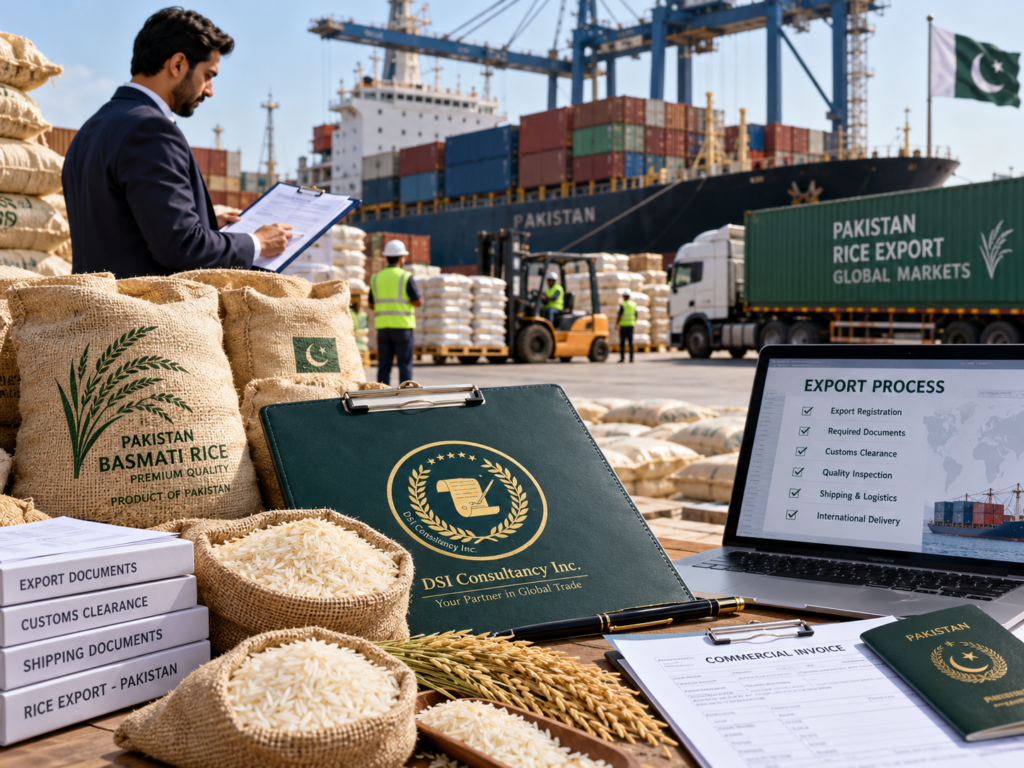
Rice export from Pakistan starts with a properly set-up business and ends with a cleared shipment and a settled payment. In between, the exporter needs correct documents, access to the Pakistan Single Window (PSW), customs clearance, and certificates such as a phytosanitary certificate. In 2026, the government also introduced a new rice export incentive.
Quick Facts
- PSW is the main filing system. Exporters file the export declaration and track approvals online.
- A general exporter registration is no longer required. Product and destination rules still need checking.
- Each rice type has its own tariff code. Brown, basmati, other milled, and broken rice use different Pakistan Customs Tariff (PCT) codes.
- The phytosanitary request starts with the export declaration. The Department of Plant Protection (DPP) processes it through PSW.
- A 2026 incentive supported rice exports. The Drawback of Local Taxes and Levies (DLTL) scheme paid a share of the export value.
What Are the Current Rice Export Guidelines in Pakistan?
Several government bodies share the work.
- Ministry of Commerce. The Ministry sets export policy through the Export Policy Order, 2022, as amended.
- Pakistan Customs. Customs checks export declarations and clears consignments.
- Pakistan Single Window. PSW is the online system for export filing and approvals.
- Department of Plant Protection. DPP issues the phytosanitary certificate that importing countries may require.
- Trade Development Authority of Pakistan (TDAP). TDAP provides export guidance and preferential certificates of origin.
Requirements can differ by rice type and destination country. Check the latest Ministry of Commerce notifications before each new contract.
Who Can Export Rice from Pakistan?
The basic rice export requirements in Pakistan cover business setup, banking, and PSW access.
- Business and tax registration. Set up the business and get a National Tax Number (NTN) from the Federal Board of Revenue.
- Bank account. Open an account with a bank authorised to handle foreign exchange.
- PSW registration. Subscribe with your NTN, Computerised National Identity Card (CNIC), a mobile number in your name, and the email linked to your NTN.
- Biometric check. Complete PSW’s biometric verification at a National Database and Registration Authority (NADRA) e-Sahulat centre.
- Bank profile link. Link your bank profile to your business profile in PSW before filing an export declaration.
DSI Consultancy’s guide to import and export registration requirements covers the wider business setup.
Do You Need a Special Licence to Export Rice from Pakistan?
TDAP’s export guidance states that a general importer or exporter registration is no longer required. The Export Policy Order, 2022 can attach conditions to particular goods, and importing countries set their own rules. Check both before each contract.
How Can You Export Rice from Pakistan Step by Step?
The rice export procedure in Pakistan has seven steps.
- Establish the exporting business. Complete your business setup, NTN, bank account, and PSW registration before you take orders.
- Identify the rice type and destination market. Decide whether you are selling basmati, non-basmati, brown, or broken rice, and find its PCT code. Then check the destination country’s rules for it.
- Finalise the buyer agreement. Record the quantity, specifications, payment terms, and shipping conditions in a written contract. Your invoice should later match these terms.
- Prepare the shipment documents. Draft the commercial invoice and packing list, book the shipment, and gather payment details. Confirm early which certificates are needed.
- File the export declaration through PSW. Submit the Single Declaration (Export), which is the online form that declares your goods to Customs.
- Complete inspections and customs clearance. Customs or DPP may review your documents or ask for an inspection. Answer each request quickly, because release waits for these checks.
- Dispatch the shipment and finish post-shipment work. Collect the bill of lading or air waybill and complete the bank settlement. Keep records and check whether any incentive applies.
Which PCT Code Applies to Your Rice?
The Pakistan Customs Tariff lists rice under heading 10.06. The code identifies your rice, and the 2026 DLTL rates depend on it.
- 1006.2000. This code covers husked (brown) rice.
- 1006.3010. This code covers semi-milled or wholly milled basmati rice.
- 1006.3090. This code covers other semi-milled or wholly milled rice, including non-basmati varieties.
- 1006.4000. This code covers broken rice.
How Does the PSW Export Declaration Work?
PSW’s Single Declaration (Export) process runs through six stages.
- Consignment information. PSW fills in your NTN, and you choose the Customs office.
- Package details. You enter the number and type of packages.
- Financial instrument. You record how the buyer will pay, such as by letter of credit or advance payment.
- Commodity information. You add details of the rice.
- Documents. You upload the supporting documents.
- Review and validation. You check every entry and then validate the declaration.
DSI Consultancy handles customs clearance for import and export shipments if you want help with filing.
What Documents Are Required for Rice Export from Pakistan?
Not every shipment needs every rice export document listed here.
- Commercial invoice. The invoice shows the buyer, the rice, the quantity, and the value.
- Packing list. The packing list shows how the rice is packed.
- Export contract or purchase order. The contract records the agreed terms.
- PSW export declaration. The Single Declaration (Export) declares the shipment to Customs.
- Banking records. These records show how payment is made and settled.
- Bill of lading or air waybill. The transport document confirms the carrier has received the cargo.
- Phytosanitary certificate. The certificate shows the rice meets the importing country’s plant-health rules.
- Certificate of origin, where required. The certificate confirms the rice comes from Pakistan.
- Other certificates. Some buyers or destinations ask for extra certificates.
How Can Rice Exporters Obtain a Phytosanitary Certificate in Pakistan?
A phytosanitary certificate for rice export is an official document showing that the shipment meets the importing country’s plant-health rules.
According to PSW’s guidance on DPP export certificates, the system generates the request when you submit the Single Declaration.
- Documents. PSW shows a checklist of the documents DPP requires.
- Further information. If DPP needs more, PSW notifies you, and you upload what it asks for.
- Inspection. Some consignments may need inspection or other checks before approval.
- Issuance. The approved certificate carries a QR code, so it can be verified online.
- Clearance. PSW automates certificate processing to support port clearance.
Check the importing country’s plant-health requirements before preparing the shipment.
What Changed for Rice Exporters Under the DLTL Scheme in 2026?
The Ministry of Commerce issued the Drawback of Local Taxes and Levies for Rice Order, 2026 on 23 January 2026. The Order’s stated purpose is to return local taxes and levies collected from the rice sector.
The drawback is a percentage of the free on board (FOB) value. FOB value is the value of the goods once they are loaded for export. The Order set two rates.
| Rate | Rice covered (PCT code) | FOB condition |
| 9% | Basmati (1006.3010) and brown (1006.2000) | At least US$ 750 per metric ton |
| 3% | Brown (1006.2000), other milled (1006.3090), and broken (1006.4000) | Below US$ 750 per metric ton |
The Order also set claim conditions.
- Original window. Shipments made from 23 January to 30 June 2026 could qualify.
- Realised proceeds. A claim was allowed only after the export proceeds were fully received, under State Bank of Pakistan (SBP) instructions.
- Automated processing. After the bank confirmed settlement to PSW, PSW sent the claim to the SBP electronically. PSW briefed Rice Exporters Association of Pakistan (REAP) members on this process in February 2026.
- Records and penalties. Drawback receipts must appear in the exporter’s accounts, and fraudulent claims can lead to a penalty.
A Ministry notification dated 15 July 2026 extended the shipment window to 30 September 2026, according to press reports.
Can Rice Exporters Still Submit DLTL Claims in 2026?
The reported extended window ran to 30 September 2026, which has passed. Do not assume that new shipments or outstanding claims still qualify. Confirm with the Ministry of Commerce and PSW first.
DLTL differs from two other programmes.
- Customs duty drawback. This Customs Act refund relates to duty on imported goods used to make exports.
- Export Facilitation Scheme (EFS). This scheme lets eligible exporters import inputs for export production without certain duties and taxes.
What Common Problems Can Delay Rice Exports from Pakistan?
Many export problems begin before the shipment reaches Customs. Wrong product details, missing certificates, inconsistent invoices, or unchecked destination rules can trigger corrections or further checks.
- Incorrect PCT code. A wrong code misdescribes the rice, so confirm it against the tariff.
- Mismatched documents. Differences between the invoice, packing list, and declaration raise questions, so compare them.
- Incomplete phytosanitary documents. Missing papers can hold up the certificate, so follow DPP’s checklist in PSW.
- Unchecked destination rules. The buyer’s country may need extra certificates, so confirm its rules early.
- Wrong quantities or descriptions. Errors in weight or rice type create mismatches, so check them before filing.
- Incomplete PSW or bank details. A missing bank profile link can stop the filing, so complete your profile first.
- Unanswered requests. An open Customs or DPP request keeps the shipment waiting, so check PSW notifications.
When Should Rice Exporters Get Professional Customs Support?
Professional help may be useful when the exporter faces:
- A first shipment. PSW, banking, and documents are all new.
- Documentation questions. The required documents are unclear.
- Declaration or classification issues. Customs has questioned the declaration or PCT code.
- PSW compliance questions. Registration, profiles, or filing need attention.
- Unclear rules or incentives. The applicable rules or incentives are uncertain.
DSI Consultancy offers consulting support for Pakistani exporters on customs clearance, export documentation, and compliance.
Frequently Asked Questions About Rice Export from Pakistan
What documents are required to export rice from Pakistan?
Most shipments need a commercial invoice, packing list, contract or purchase order, the PSW export declaration, and banking records. A bill of lading or air waybill and a phytosanitary certificate are usually needed too. A certificate of origin and other certificates depend on the buyer and destination.
Do I need an export licence to sell rice overseas?
TDAP’s guidance states that a general exporter registration is no longer required. The Export Policy Order, 2022 can set conditions for particular goods, and the importing country may have its own rules. Check the latest notifications and your buyer’s requirements before signing a contract.
How can I register for rice exports through Pakistan Single Window?
Subscribe on the PSW website with your NTN, CNIC, a mobile number registered in your name, and the email linked to your NTN. Then complete biometric verification at a NADRA e-Sahulat centre. Before filing an export declaration, link your bank profile to your business profile in PSW.
Is a phytosanitary certificate necessary for rice exports?
Importing countries often require one to confirm the rice meets their plant-health rules. In Pakistan, the Department of Plant Protection issues it through PSW. The request is generated automatically when you submit the Single Declaration (Export), and the approved certificate carries a QR code.
What is the DLTL scheme for rice exporters in 2026?
The Drawback of Local Taxes and Levies for Rice Order, 2026 paid eligible exporters a share of the free on board value. Basmati and brown rice at US$ 750 per metric ton or more earned 9%, and listed rice below that value earned 3%. Check the latest notification for current status.
How Can Rice Exporters Prepare for a Successful Shipment?
Verify the rules for your rice and destination. Prepare matching documents, complete your PSW filing, and confirm certificate needs. Keep full records. Before your next rice shipment, book a document and filing review with DSI Consultancy.